Mylestock: A Bold, Readable Handwritten Font for Crafters
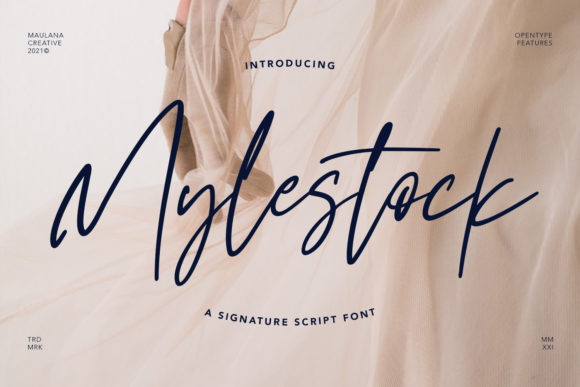
As someone who designs printable wall art, cuts vinyl stickers for boutique shops, and hand-presses greeting cards for local markets, I’ve learned that not every handwritten font holds up in real-world production. That’s why Mylestock stood out the moment I tested it on my Cricut—smooth curves, confident weight, and zero readability compromises. It’s not just decorative; it’s functional. Designed as a modern script font within the Script Amp category, Mylestock bridges elegance and clarity in a way few premium fonts do.
What makes Mylestock special isn’t just its stylish flow—it’s how it behaves at different sizes and materials. The boldness gives it presence on product packaging and signage, while the open letterforms and consistent spacing keep it legible even at 14pt on a candle label or 8mm-high sticker. Unlike fragile scripts that blur when printed small or cut thinly, Mylestock’s clean joins and balanced contrast hold up beautifully on matte paper, kraft tags, glossy vinyl, and even heat-transfer vinyl for mugs and totes.
I use Mylestock most often for handmade labels—especially for apothecary-style products like bath salts, soy candles, and herbal teas. Its smooth curves evoke craftsmanship without looking overly ornate, and customers consistently comment on how “premium” the packaging feels. For wedding stationery, I pair Mylestock with a crisp sans serif (like Montserrat or Inter) for names and dates—Mylestock handles “Emma & James” with warmth, while the supporting font keeps addresses and timelines clean and scannable. It’s also become my go-to for farmhouse-style signs, where its bold yet organic rhythm adds personality without competing with rustic wood grain or chalkboard textures.
For digital printables—think planner pages, quote posters, or seasonal SVG bundles—I rely on Mylestock’s versatility. It works equally well as a single-word title (“Grateful”, “Hello Spring”) or as a short phrase (“Hand-poured • Small Batch • Made with Love”). Because it’s built for display use—not body text—it shines brightest in headlines, headers, and focal points. Don’t try to set full paragraphs in it, but do use it confidently for welcome boards, boutique price tags, holiday gift wrap stamps, or embroidered tote bag monograms. Its natural rhythm invites pause and connection—exactly what handmade buyers respond to.
Real-World Readability Tips for Makers
Here’s what I’ve learned after using Mylestock across dozens of physical and digital projects:
- For cutting machines: Use the OTF version with vector outlines—no rasterized edges. Adjust your machine’s “cutting pressure” slightly lower than usual; Mylestock’s smooth curves cut cleanly without jagged corners or skipped joins.
- For small stickers and tags: Stick to uppercase for maximum clarity (e.g., “LOCAL HONEY” instead of “local honey”), and avoid tight kerning below 16pt. The font includes standard ligatures and stylistic alternates—enable them in your design app for refined “fi”, “fl”, and “ct” connections.
- For printed cards and invitations: Print at 300 DPI and use a coated or semi-gloss stock—the bold weight pops without bleeding, and the curves retain definition.
- For mockups and social previews: Mylestock renders clearly on screens, so your Etsy thumbnails and Instagram product shots look sharp and intentional—not fuzzy or over-styled.
Smart Pairings That Elevate Your Brand
Mylestock thrives when paired intentionally. As a script font, it needs breathing room and contrast. My most-used combos:
- Mylestock + Poppins (sans serif): Clean, friendly, and highly legible—ideal for craft business logos, shop banners, and digital download covers.
- Mylestock + Playfair Display (serif): Adds editorial polish for wedding suites, boutique packaging, or artisanal food labels—great for balancing warmth and authority.
- Mylestock + a minimalist monospace (like IBM Plex Mono): Unexpected but effective for modern maker brands—think tech-meets-handmade stationery or coding-themed printable planners.
Each pairing supports Mylestock’s expressive voice while grounding your design in function. That balance is critical when you’re building repeatable brand identity across labels, web graphics, and social posts.
Licensing & Commercial Use You Can Trust
If you sell physical goods, digital templates, SVG files, or client-branded assets, confirm your license covers commercial use—and Mylestock does. Whether you’re bundling it into Canva templates, embedding it in editable PDF planners, or using it to cut vinyl decals for resale, the included license permits all of it. No hidden restrictions. Just make sure you’re working from the official download (not a free knockoff), and keep your proof of purchase handy—it’s peace of mind when scaling your shop.
Mylestock also ships in multiple formats—OTF, TTF, and WOFF—so it works across desktop apps, web builders, and cutting software. While it doesn’t include extended Latin or Cyrillic glyphs, it covers English, Western European, and common punctuation thoroughly. If your shop serves U.S., Canadian, UK, or Australian markets, you’ll find full support for accents, fractions, and currency symbols needed for pricing and product details.
At its core, Mylestock isn’t just another handwritten font. It’s a tool that helps handmade sellers communicate care, quality, and intention—without sacrificing practicality. When your customer sees “Small Batch • Hand-Poured • Made in Ohio” in Mylestock on a jar label, they don’t just read the words—they feel the story behind them. That’s the quiet power of thoughtful typography: it turns craft into connection, and products into meaning.